
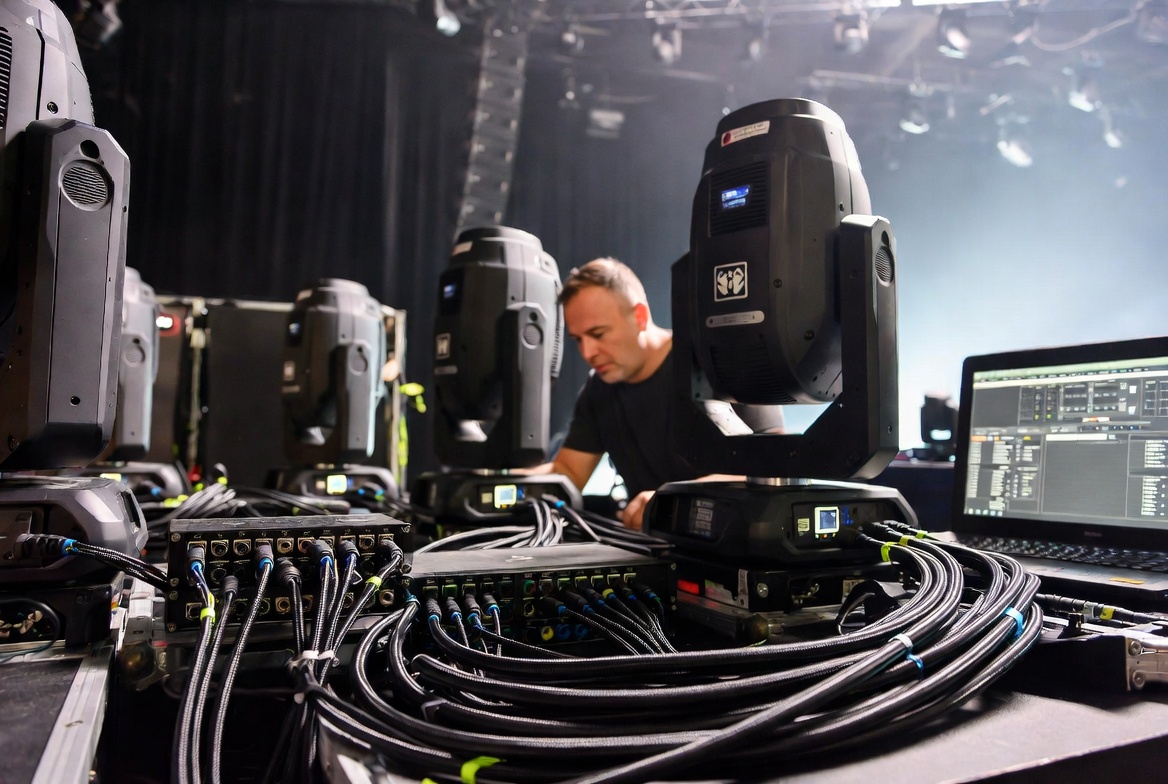
In professional stage lighting and architectural entertainment technology, data integrity is the boundary line between a flawless, high-impact performance and a catastrophic system-wide failure. The Digital Multiplex (DMX512) protocol is a remarkably robust serial communication standard, but it relies entirely on a physical framework of cables, connectors, topology layouts, and hardware line terminators that must meet uncompromising electrical criteria.
When transmission signals degrade within the data pipeline, the physical real-world results manifest as erratic moving head calibration panning, randomly firing strobe fixtures, laggy tracking, or complete blackout conditions mid-show. This comprehensive technical manual outlines the precise engineering mechanics of high-frequency DMX data transmission and provides an actionable blueprint for constructing a reliable, tour-grade data infrastructure.
1. What is the DMX512 Protocol? Technical Foundations
DMX512 stands for Digital Multiplex with 512 discrete control channels per data universe. Governed globally under the ANSI E1.11 standard, the protocol transmits asynchronous serial data at a fixed, unyielding transmission rate of 250 kilobits per second (kbps).
Electrically, the protocol is built upon the EIA-485 (RS-485) differential signaling standard. Instead of relying on a single data wire and a common ground reference point—which is highly susceptible to surrounding electrical noise—EIA-485 utilizes a balanced differential pair consisting of a Data Negative line (Pin 2) and a Data Positive line (Pin 3). The console transmitter sends inverted voltage signals across these two copper lines simultaneously. The receiving lighting fixture monitors only the voltage difference between the two lines, effectively canceling out any uniform external electromagnetic noise that penetrates the cable shield.
Because it handles high-frequency data states, DMX data streams require specialized digital data cabling capable of transferring fast, high-speed square waves without rounding off the voltage curves or distorting the signaling bit transitions.
2. The Golden Rules of DMX Network Architecture
To prevent data packet corruption across a complex lighting rig, your physical cabling network must adhere to three strict architectural and electrical constraints:
H3: Rule A: The Daisy-Chain Configuration Only
DMX signals must travel in a strict, singular, continuous path originating from the control desk or node to the first fixture, and then passing linearly from fixture to fixture.
You must never introduce passive Y-splitters, microphone stage boxes, or hardwired T-junctions to split a data line in multiple directions. Splitting an EIA-485 digital signal line passively instantly disrupts the characteristic impedance of the transmission environment, causing severe data fragmentation and mirroring loops. If a venue layout or truss architecture dictates routing data streams in separate physical directions, you must install an active, optically isolated DMX splitter or distributor. These devices ingest the primary signal, replicate the data packet digitally via optocouplers, and isolate output lines safely across independent, amplified branches.
Rule B: Maximum Run and Physical Fixture Thresholds
- Maximum Hardware Fixture Count: You can daisy-chain a maximum of 32 physical lighting devices inline on a single continuous unamplified data stream loop. Exceeding this device threshold overloads the RS-485 transceiver chips installed within the fixtures, lowering the operational network voltage beneath readable digital thresholds and inducing downstream packet drops. PDF+ 3
- Maximum Continuous Cable Length: A single continuous DMX cable run from your transmitter origin to the final device must never exceed 1,000 feet (300 meters). While the protocol technically supports this threshold under laboratory conditions, real-world deployment on noisy festival stages demands installing an active opto-splitter or line repeater every 500 feet to preemptively combat signal attenuation. PDF+ 3
H3: Rule C: Mandatory Network Line Termination
At the absolute terminal end of every single DMX daisy-chain loop, you must insert a physical hardware DMX terminator into the open, female XLR output port of your final lighting fixture.
Without a proper terminator inline, high-speed voltage packets slam directly into the electrical barrier of the open connector pins and reflect backward along the copper core. This behavior creates high-frequency signal reflections and electrical echoes that crash head-on into incoming valid data commands, causing pan/tilt axis jitter and timing synchronization drops across your fixtures.
3. Essential Technical Specifications for DMX Components
When evaluating, sourcing, or custom-building production-grade cabling assets, utilize this standardized data specification baseline to verify electrical compliance with high-frequency multiplex digital signals:
- Characteristic Impedance: 110 to 120 Ohms strictly matched. Common Failure Symptom: High signal reflections, high-speed data collisions, and erratic automated fixture panning.
- Cable Core Capacitance: Low, ideally under 15 pF/ft preferred. Common Failure Symptom: Waveform rounding of sharp square wave transitions, leading to severe downstream data dropouts.
- Shielding Matrix Layout: Dual-Shield consisting of a Foil wrap and a Tinned Copper Braid. Common Failure Symptom: Extreme vulnerability to Electromagnetic Interference (EMI) from adjacent high-voltage trunks.
- Line Termination: 120-Ohm, 1/4-Watt metal film resistor soldered clean between pins 2 and 3. Common Failure Symptom: Continuous random flickering, strobing behavior, and axis tracking losses across the entire chain.
4. Advanced System Architecture: Designing a Large Rig Topology
When engineering data networks for major multi-truss applications or large-scale permanent installations, you cannot plan your layout using basic linear thinking. Sizing a system strictly for current fixture counts while ignoring systemic loading profiles is why installations fail under peak stress conditions.
To safely scale data pipelines across a major layout, deploy a Star Topology leveraging an optically isolated data splitter directly after your main control system or Art-Net/sACN node. By mapping the system into distinct, isolated branch runs, you isolate hardware issues to individual zones. If an internal transceiver chip shorts out or a cable shield ruptures on Truss Alpha, the optical barrier within the splitter prevents that fault from traveling upstream, keeping Truss Beta and Truss Gamma running flawlessly. Furthermore, ensure that data trunks run entirely separate from your heavy power lines. Maintain a minimum physical gap of 12 inches during parallel runs to avoid inductive electromagnetic hum, and enforce the 90-Degree Cross Trick wherever control wires must cross high-current 3-phase lines.
5. Technical Troubleshooting & Integration FAQ
Can I deploy structured Cat5e or Cat6 twisted-pair cabling for professional DMX distribution?
Yes, the official PLASA/ESTA standard explicitly permits using Category 5e (Cat5e) or Category 6 (Cat6) twisted-pair data cables within fixed, permanent installations. Standard network cable possesses an intrinsic characteristic impedance of approximately 100 Ohms, which aligns close to the protocol requirement, while its precise internal wire twists provide natural rejection against electromagnetic noise. However, for entertainment spaces, you must mandate Shielded Twisted Pair (STP) options to handle surrounding stage noise and follow uniform termination pinning standards (such as T568B) to guarantee data stability.
What is the mathematical difference between DMX channel limits and hardware limits?
The 512-channel limit of a specific data universe is completely separate from the 32-device physical electrical loading constraint. For example, if you deploy modern profile moving lights that require 30 parameters each to operate zoom, gobo flags, prisms, and pan tracking, a cluster of 17 fixtures will mathematically fill an entire data universe (17×30=510 channels). While you are well below the physical loading limit of 32 hardware transceivers, you have run out of channel allocation slots. Conversely, if you connect 40 small LED puck lights that only require 3 channels each (40×3=120 channels), you are using less than 25% of your channel capacity, but you have violated the physical hardware threshold and will drop data packets due to line voltage attenuation.
How do I deploy a “Half-Split” diagnostic method under production show time constraints?
When a lighting system experiences erratic glitches right before doors open, you cannot waste time checking individual cables. Move directly to the physical midpoint of your broken daisy chain. Unplug the incoming line from that midpoint device and inject a clean control signal directly into it via a standalone testing console or wireless transmitter. If the downstream fixtures continue to show flickering artifacts, the broken line or failing device resides entirely in the second half of the network rig. If the glitches cease instantly, the corrupted connection, internal trace failure, or cold solder point is located in the front half of the path. Repeat this split process within the compromised zone to pinpoint the exact failure location in minutes.
6. Essential Technical Specifications for DMX Components
| Component / Metric | Industry Standard Requirement | Common Failure Symptom |
| Characteristic Impedance | 110 to 120 Ohms | Signal reflections, erratic fixture panning |
| Cable Capacitance | Low (under 15 pF/ft preferred) | Rounded square waves, data dropouts |
| Shielding Matrix | Foil + Tinned Copper Braided | Susceptibility to electromagnetic interference (EMI) |
| Termination | 120-Ohm, 1/4-Watt Resistor soldered between pins 2 and 3 | Random flickering across entire chain |
Blockages in data pipelines kill live events. Eliminate data crosstalk, voltage attenuation, and backstage panic by upgrading your production setup with Gig Tuff Tour-Grade DMX Cables. Specifically engineered with ultra-low capacitance cores, true 110-Ohm characteristic impedance parameters, and ruggedized dual-shielding matrix construction, Gig Tuff infrastructure keeps your control data flowing flawlessly under heavy stage stress.